1960 - 1990
The origins
The origins of IfG Institut für Gebirgsmechanik GmbH date back to the era of the GDR.
The establishment of the Institut für Bergbausicherheit (Institute for Mine Safety) as a scientific and technical institution was decided on 27 August 1959 by the Presidium of the Council of Ministers of the GDR. It was placed directly under the Supreme Mining Authority of the Council of Ministers of the GDR, the state mining regulatory body. The Institute began operations in January 1960 and included several branches, such as the Freiberg Test Tunnel, the Central Institute for Explosion and Fire Prevention in Mining and Industry, and the Research Center for Technical Dust Control in Eisleben.
Its responsibilities were broad and encompassed all aspects related to, among other things
- underground mining safety,
- mining technology,
- geological safety of repositories and
- impacts on the Earth's surface.
Organisationally, the institute was divided into the Leipzig and Freiberg divisions, each comprising three research departments. Dr.-Ing. Karl-Heinz Höfer was appointed director, and Dr.-Ing. Klaus Thoma Head of the Rock Mechanics Department.
In 1970, the Institute for Mine Safety was renamed the Institute for Mining Safety (IfB). This change was accompanied by a restructuring and the definition of key research fields:
- Geomechanics, comprising the departments of Rock Mechanics and Salt Mechanics (thereby making the IfB responsible for all potash and rock salt mining in the GDR)
- Fire and Explosion Protection
- Workplace Hygiene
- Shaft Hoisting Systems and Wire Ropes
The IfB was notable for its extensive international collaboration with scientific and technical institutions in the Eastern Bloc on mining safety issues, as well as its close cooperation with the so-called non-socialist economic area.
In 1991, the Institute for Mining Safety was formally dissolved as part of the german reunification process. The last Director was Dr.-Ing. Klaus Thoma, and the Head of the Geomechanics/Salt Mechanics Department was Dr.-Ing. Wolfgang Menzel.
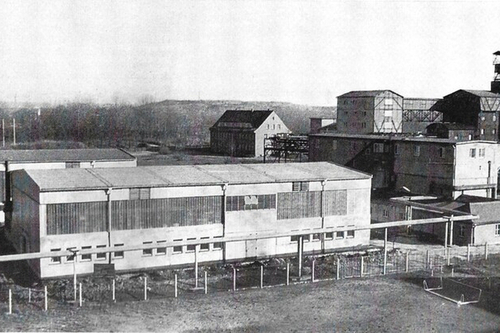
The buildings of the Institute for Mining Safety in 1975. In the foreground is the fire and explosion protection testing hall; to the right of it is the Südwerkbunker (a former coal storage bunker), which is now used by IfG.
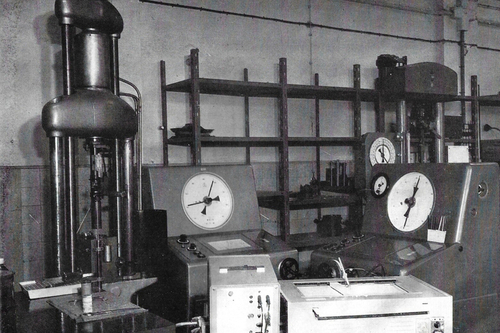 Testing machines used by the Institute for Mining Safety in 1975.
1990
Founding of IfG Institut für Gebirgsmechanik GmbH
On 21 December 1990, IfG Institut für Gebirgsmechanik GmbH was founded by former employees of the IfB, with the participation of Verbundnetz Gas AG, UGS Mittenwalde, Professors Fecker, Reik, and Fröhlich, and KIB Plan Erfurt.
Dr.-Ing. Wolfgang Menzel and Dipl.-Phys. Wolfgang Schreiner were appointed managing directors.
1991
IfG launches
The IfG was established in 1991 with twelve employees who had previously worked at the former IfB in the fields of rock mechanics and, primarily, salt mechanics.
During the economically uncertain following German reunification, this enabled the creation of new professional prospects for the staff while preserving their valuable expertise. As a result, IfG was able to establish a high level of technical credibility and acceptance among clients and regulatory authorities across Germany in the early 1990s. The main focus was on topics related to rock mechanics and geotechnics in salt mining, underground waste disposal, final disposal, and underground gas storage.
With the decision to adopt a discontinuum-based numerical modelling approach (UDEC by ITASCA) and the acquisition of PCs equipped with mathematical coprocessors, the foundation was laid for the development of high-performance geomechanical computing capabilities. In addition, the rock mechanics laboratory and in-situ measurement technology were integrated into IfG from the outset. This established the foundations that continue to define IfG today as an integrated engineering organisation, comprising closely interconnected structural areas: field measurement, laboratory testing, and rock mass modelling.
1995
Purchase of real estate
A portion of the site of the former 'Schacht Dölitz', along with the associated buildings in which IfG operates, was acquired by the Free State of Saxony and adapted to meet the company’s operational requirements. Parallel to the renovation and refurbishment works, the technical equipment was continuously upgraded.
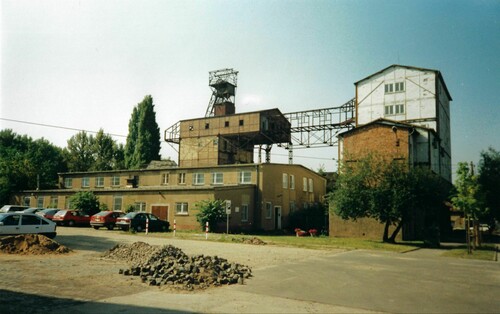
Exterior view of the IfG premises in 1996.
1998
Certification
The IfG is has been continuously certified to ISO 9001 since 1998.
2002
Change in Management
Dr.-Ing. habil. Wolfgang Minkley takes over the leadership of the institute from Dr. Menzel. Dr. Minkley, a physicist with a doctoral degree, had already been active at IfB in the field of rock mechanics. He completed his habilitation as a member of IfG at the TU Bergakademie Freiberg, focusing on the mechanisms and prediction of rockbursts in potash mining.
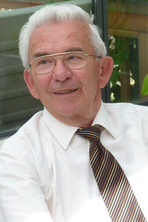
Dr. Wolfgang Menzel
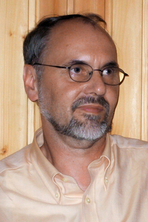
Dr.-Ing. habil. Wolfgang Minkley
2003
Purchase of a large-scale shearing machine
The acquisition of the MTS 816 large-scale servo-hydraulic shear machine significantly expanded experimental capabilities. In the meantime, all servo-hydraulic testing systems have been equipped with digital measurement and control systems from MTS.
2007
Testing machine upgrade
The RBA 2500 servo-hydraulic testing machine from Schrenk-Trebel is undergoing a complete overhaul.
2009
Modernisation and renovation
The SMH 250 servo-hydraulic testing machine is also undergoing a comprehensive modernization and refurbishment.
2010
Change in Management
The second Managing Director, Dipl.-Phys. Wolfgang Schreiner, retires. Dr. Till Popp assumes the role of authorized signatory.
2011
Purchase of a D2000 testing machine
To expand the portfolio, a D2000 servo-hydraulic testing machine from GL Test-Systems is being purchased.
2014
Purchase of the 'Südwerkbunker' property
The IfG acquires the property of the former coal bunker of the 'Schacht Dölitz' lignite underground mining complex ('Südwerkbunker')—in order to create additional office space and begins the conversion and renovation of the building.
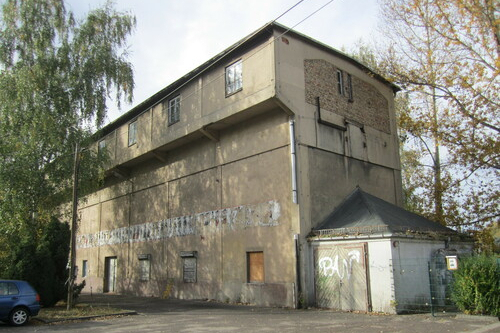
Condition of the Südwerkbunker in 2012, prior to renovation.
2018
Moving into new office space in the Südwerkbunker
The extensive conversion and renovation works on the South Plant Bunker have been completed. Architectural features have been preserved. As a result, the rock mass modelling department now has twelve modern office workstations, as well as a large meeting room. Additionally, the field testing department has been provided with a new workshop area.
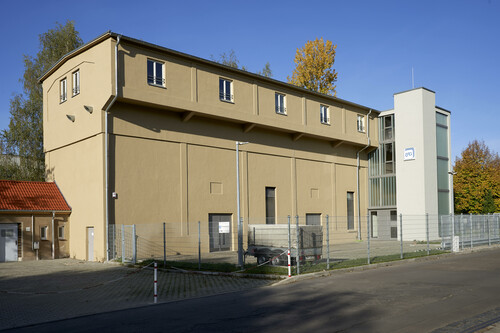 The extensively renovated Südwerkbunker provides our employees with modern workspaces.
2020
Change in Management
In January 2020, Dr.-Ing. Ralf-Michael Günther takes over as managing director from Dr.-Ing. habil. Wolfgang Minkley. Dr. Günther completed a mining apprenticeship with a high school diploma at the "Werk Kupferschieferbergbau" from 1984 to 1987 and studied geotechnical engineering at the TU Bergakademie Freiberg from 1990 to 1995. After graduating, he joined IfG as a graduate and earned his doctorate in 2009 at the company in the field of salt mechanics.
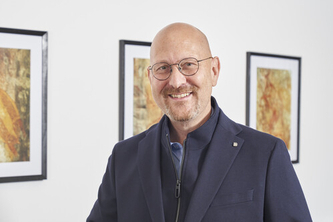
Dr.-Ing. Ralf-Michael Günther
2020
Renovation of the 'Kaue'
Starting in 2020, extensive renovation work begins on the main building, known as 'Kaue', the former dressing rooms of the lignite miners at Schacht Dölitz.
2021
Modernisation of the D5000 Testing Machine
The D5000, which, with a test force of 5 MN, is the largest and oldest testing machine at the IfG, is undergoing a major overhaul and will be equipped with a new servo-hydraulic control system.
2022
Modernisation of the creep testing laboratories
The two laboratory rooms for creep testing in the Kaue are being completely renovated and equipped with new technology and a gantry crane in each room.
2023
New offices
IfG currently employs around 35 people. The demand for office space continues to grow. The “old” garage at the Südwerkbunker, which has not yet been renovated, is being repurposed and fully renovated. Four new office workstations for the field testing department are being created.
2024
Ten new creep test benches, two new pump systems
Ten additional heated hydraulic creep testing rigs will be built. This will increase the total number of testing rigs available for creep tests to 78.
In addition, two precision double-piston pump systems from Vindum will be acquired for conducting creep tests with dilatancy and permeability measurements.
2025
Change in Management
Dr. Till Popp is retiring in July after 15 years as an authorised signatory and 22 years with the company. His scientific contributions are honoured with a tribute at the 54th Geomechanik-Kolloquium in November.