
The properties of salt rocks can often be described following a continuum mechanics approach. However, salt rock is essentially a polycrystalline material that is frequently interspersed with separation surfaces (e.g., lithological layer surfaces, clay layers, etc.). In many cases, the mechanical and hydraulic behavior is largely determined by these separation surfaces:
- Fracture events, ranging from roof falls to sinkholes and rock bursts, are inherently discontinuous processes in which the rock continuum is disrupted, leading to significant deformations along layer or fracture surfaces.
- In undamaged rock salt, fluids can only spread along grain boundaries if the fluid pressure exceeds the corresponding normal stress. The percolation threshold and the direction of fluid spread are then determined by the stress state in the rock. This process can be conservatively addressed by the minimum stress criterion in the framework of continuum mechanics.
Furthermore, the fluid pressure on layer surfaces reduces the effective stress and thus diminishes the shear strength.
Static and dynamic load scenarios, as well as hydraulic issues, can be evaluated in either continuum or discontinuum mode, depending on the specific requirements.
 |
||||
|
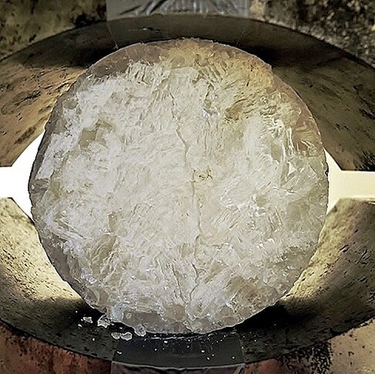
Brazilian test in the rock mechanics laboratory of the IfG. |
Brazilian test recalculated using a continuum mechanics approach. |
| Discontinuum mechanical model of the buckling of an underground pillar. |
In contrast to the classic continuum mechanics approach, we evaluate barrier integrity (VSG, KOSINA, Minkley, Mühlbauer, Lüdeling, 2016) in discontinuum modeling not macroscopically, based on the minimum principal stress or damage parameters, but directly from the network of connected pathways.
In such percolation calculations (Knauth, 2018) the explicit investigation of possible fluid pathways along grain boundaries in polycrystalline materials such as rock salt or in fractured rock is carried out. This allows the directional dependence of the pathways to be taken into account. In the model, the rock mass is composed of discrete blocks with separating surfaces between them.
| Example of pressure-driven percolation in an isotropic stress field. | Example of pressure-driven percolation in an anisotropic stress field. |